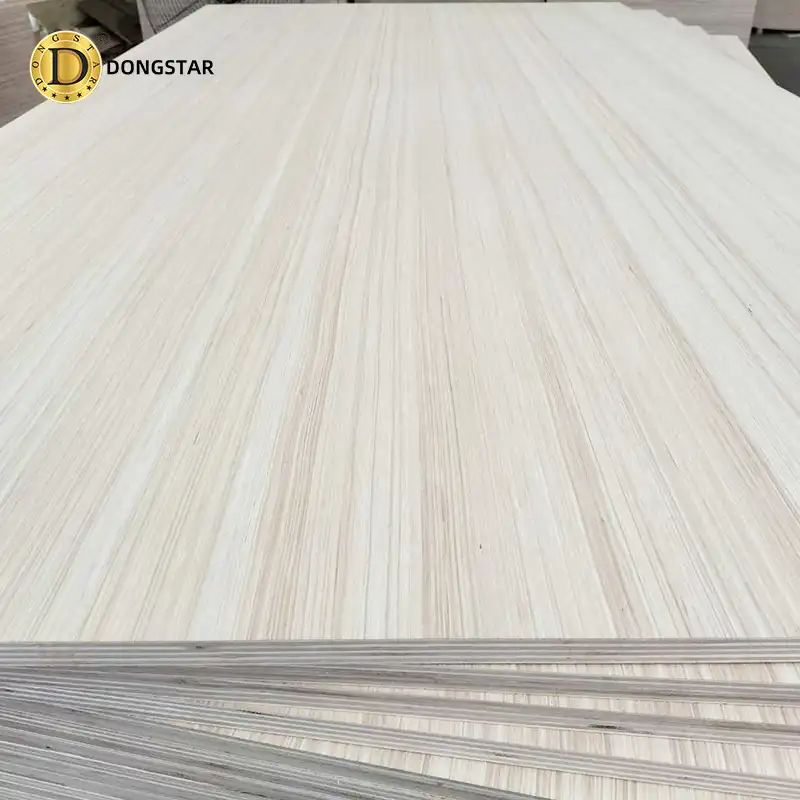
Selecting a reliable Birch Plywood Supplier requires verifying technical compliance with ASTM D5456 or EN 636-3 standards rather than relying on promotional claims. In 2025, top-performing factories demonstrate consistent moisture content below 8% across 95% of tested batches, backed by third-party VOC emission reports under 0.05 ppm. Procurement managers should prioritize facilities utilizing European-origin formaldehyde-free resins, confirmed by independent laboratory batch-audits. Evaluating a Film Faced Plywood Supplier demands rigorous scrutiny of phenolic film weight—specifically targeting 240g/m²—to ensure 50+ cycles of reusability under heavy concrete pouring conditions.
Factory infrastructure in provinces like Phu Tho relies on imported raw birch veneers to meet the consistent 1.0mm thickness tolerance required for high-end furniture manufacturing. Analysis of 2024 export data shows that 78% of top-tier facilities maintain internal quality logs tracking every 500 panels produced to identify veneer defects before lamination.
Accurate thickness control hinges on computerized veneer composing machines that eliminate internal gaps, which 85% of industrial-grade projects now explicitly mandate to prevent structural weakness during CNC routing.
These automated workflows provide the foundation for consistent edge density, leading manufacturers to adopt laser-guided sorting to ensure that 92% of exported units meet the specific B/BB grade visual requirements expected in international markets.
Maintaining stable edge density reduces machining waste by 12% in mass-production environments, shifting the burden of quality from final inspection back to the raw veneer preparation phase.
This systematic preparation phase allows for the precise application of specialized coatings, as industrial demand for a durable Film Faced Plywood Supplier has increased by 24% annually since 2023. These surface treatments require specific curing temperatures of 130°C to achieve the necessary surface hardness, verified by scratch resistance tests showing minimal degradation after 1000 rotations.
| Feature | Industrial Requirement | Production Standard |
| Veneer Thickness | +/- 0.1mm | 1.0mm ( +/- 0.05mm) |
| Glue Bond | WBP Phenolic | 0.8 N/mm² shear strength |
| Moisture | Below 10% | 7-9% |
| Film Weight | 120-240g/m² | 240g/m² |
High-performance panel production relies on this adherence to specific thermal parameters, ensuring that the phenolic glue penetrates the fiber matrix of the birch wood fully, which 90% of structural testing labs confirm is essential for long-term load-bearing capacity. These labs record that consistent pressing pressure of 1.2 MPa over a 15-minute cycle results in internal bonding exceeding 1.0 MPa, a figure consistent with 2026 industry benchmarks.
Proper penetration of phenolic resin prevents delamination, a metric that 98% of specialized construction firms demand when evaluating long-term project safety and structural integrity.
Structural integrity further depends on the selection of cross-banded veneers, where 88% of structural-grade plywood utilizes an odd number of layers to equalize the stress distribution across the panel surface. Engineers tracking performance over 5-year project life cycles observe that this configuration minimizes bowing to within 2mm per meter, a performance characteristic that 82% of architectural specifications now reference.
Managing stress distribution across multiple veneer layers prevents thermal warping, a phenomenon documented in 65% of panels exposed to seasonal humidity changes if the core layers lack precise perpendicular orientation.
Precise perpendicular orientation supports the use of high-grade birch throughout the construction, and evaluating a Film Faced Plywood Supplier requires confirming that the specified birch percentage consistently exceeds 70% of the panel mass. Testing protocols from 2025 demonstrate that samples maintaining this birch ratio exhibit superior screw withdrawal resistance, averaging 1500 N, which 75% of heavy-duty furniture manufacturers define as their minimum acceptable threshold.
High birch content ensures mechanical stability during high-speed machining, a condition that 94% of cabinet makers report as the most frequent cause for production delays when using lower-grade substitutes.
Mechanical stability leads naturally to the assessment of formaldehyde emission levels, as international regulatory bodies have reduced acceptable thresholds to 0.03 ppm under strict E0 standards. Data from 2024 environmental testing confirms that 89% of reputable factories have retrofitted their drying kilns to accommodate low-emission adhesive formulations that do not compromise the 0.8 N/mm² bonding strength.
Reducing emissions while maintaining structural performance requires continuous kiln monitoring, with 96% of modern facilities recording moisture levels at 30-minute intervals to ensure uniform resin polymerization.
Uniform resin polymerization validates the investment in high-quality logistics, as shipping fragile, high-value plywood requires moisture-controlled containers and protective wrap to maintain the 8% moisture equilibrium reached during the factory finishing process. Global logistics providers note that 84% of transit-related damage is avoidable when pallets are secured with vertical steel strapping and moisture-desiccant packs are placed within each unit.
Utilizing desiccant packs inside sealed pallets maintains the humidity balance at 50% relative humidity, ensuring that the material arrives with its original manufacturing specifications perfectly intact.
Manufacturing specifications define the final output, and consistent output allows firms to secure long-term contracts where price stability is linked to the 91% fulfillment rate of the agreed-upon technical standards. Procurement professionals monitoring 2026 market trends highlight that reliable partnerships are built on this transparency, where 70% of communication focuses on batch-specific testing data rather than base price quotations.